Last Updated: November 18, 2025
- Rolling over your 401(k) to a Gold IRA can protect against inflation and market volatility.
- Gold IRAs require secure, IRS-approved storage for physical metals.
- Consider fees and liquidity before deciding to rollover your retirement funds.
- Ideal for retirees or investors seeking portfolio diversification and stability.
Planning for retirement can feel overwhelming, especially with the ups and downs of the stock market. Many people rely on their 401(k) as a main way to save for retirement. But with recent market swings and rising inflation, some investors wonder if their 401(k) savings are safe enough.
One popular idea gaining attention is rolling over a 401(k) into a Gold IRA. This means moving money from your traditional retirement account into an IRA backed by physical gold. Gold has been a trusted store of value for thousands of years, often seen as a safe haven during uncertain economic times.
But is a Gold IRA the right choice for your retirement? How does it compare to keeping your money in a 401(k)? What are the risks and benefits? And what exactly is involved in rolling over your account?
This article will break down everything you need to know about Gold IRAs and 401(k) rollovers. We’ll explain the basics in simple terms, so you can understand your options clearly. You’ll learn about the pros and cons, fees, tax rules, and how to decide if a Gold IRA fits your retirement goals.
With inflation rates climbing to levels not seen in decades and stock markets showing more ups and downs than usual, protecting your retirement savings is more important than ever. Adding gold to your portfolio could help balance risk and provide a hedge against inflation.
Whether you are close to retirement or still have years to go, knowing how a Gold IRA works and what it offers can help you make smarter choices with your savings.
By the end of this guide, you’ll have a clear understanding of whether rolling over your 401(k) into a Gold IRA is a good move for you or if sticking with your current plan makes more sense.
What Is a Gold IRA?
A Gold IRA is a type of self-directed Individual Retirement Account that allows you to invest in physical precious metals like gold, silver, platinum, and palladium. Unlike traditional IRAs or 401(k) plans that mainly hold stocks, bonds, and mutual funds, a Gold IRA gives you direct ownership of tangible assets.
This means your retirement savings are partly backed by actual metals, which can provide protection against certain economic risks. Because these metals have intrinsic value, many investors view Gold IRAs as a way to safeguard wealth beyond paper investments.
Why Choose Gold for Your Retirement Portfolio?
Gold as an Inflation Hedge
One of gold’s strongest appeals is its ability to protect against inflation. When prices rise, the value of paper money tends to drop, which can erode the buying power of your savings. Gold, however, has historically held its value or even increased during inflationary periods. This is because gold is a finite resource and is not tied to any single currency, making it a reliable store of value when inflation spikes.
Portfolio Diversification Beyond Stocks and Bonds
Adding gold to your retirement portfolio introduces diversification. Most traditional retirement accounts are heavily invested in stocks and bonds, which often move in similar directions during market changes. By including physical metals like gold, you spread your investment risk across different asset classes. This can help reduce the overall volatility of your portfolio and improve long-term stability.
A Safe Haven in Economic and Political Uncertainty
Gold is widely regarded as a “safe haven” asset during times of economic or geopolitical turmoil. When stock markets fall or political tensions rise, investors often turn to gold as a secure place to park their money. This demand tends to keep gold’s price steady or even push it higher, providing a layer of security for your retirement funds when other investments may be struggling.
What Is a 401(k)?
A 401(k) is a retirement savings plan offered by many employers to help employees save for their future. It allows you to contribute a portion of your paycheck before taxes are taken out, which lowers your taxable income today.
The money you put into a 401(k) is usually invested in a mix of stocks, bonds, and mutual funds chosen by you or your plan administrator. Over time, these investments have the potential to grow, helping your retirement savings increase.
Many employers also offer matching contributions, meaning they add money to your 401(k) based on what you contribute. This “free money” can significantly boost your savings over the years.
One of the main benefits of a 401(k) is that the growth in your account is tax-deferred. You don’t pay taxes on your earnings until you withdraw the money, usually after retirement. This allows your investments to compound more efficiently over time.
Why Consider Rolling Over Your 401(k) into a Gold IRA?
Facing Market Volatility and Inflation
In recent years, the stock market has been unpredictable and sometimes volatile. For example, during the early months of the COVID-19 pandemic in 2020, major indexes like the S&P 500 plunged by almost 34% in just a few weeks. On top of this, inflation surged to 9.1% in June 2022 — a level not seen in decades. These factors have made many retirees worried about the stability of their savings and how much their money will actually be worth in the future.
Protecting Your Retirement Savings
When inflation rises, the value of cash and traditional investments can shrink, reducing purchasing power. For people living on fixed incomes or retirement savings, this can be a serious concern. A Gold IRA offers a way to protect your nest egg because gold tends to hold its value or even increase when inflation is high. It acts as a financial shield during tough economic times.
Adding Stability Through Diversification
Gold has been considered a reliable store of wealth for centuries. Unlike stocks and bonds, gold is a physical asset that isn’t directly affected by company performance or interest rate changes. By including gold in your retirement portfolio, you diversify your investments and reduce overall risk. This can help smooth out swings in your portfolio value caused by stock market ups and downs.
A Hedge Against Currency Fluctuations
Gold also tends to perform well when the U.S. dollar weakens. Since retirement savings are often measured in dollars, holding gold can protect against losses caused by currency fluctuations. This makes a Gold IRA an attractive option for those wanting to safeguard their wealth against multiple financial risks.
Understanding the Gold IRA Rollover Process
Rolling over your 401(k) into a Gold IRA means moving your retirement savings into a specialized self-directed IRA that lets you invest in physical precious metals like gold and silver. Unlike traditional IRAs or 401(k)s, a Gold IRA requires working with a custodian who handles these unique assets. This process is designed to be tax-efficient and penalty-free if done correctly, giving you control over adding tangible wealth to your retirement portfolio.
Key Steps to Roll Over Your 401(k) into a Gold IRA
The first step is to choose a trusted custodian experienced in managing Gold IRAs. Not every IRA provider supports precious metals, so it’s important to research and find a company with strong reviews and transparent fees. After selecting your custodian, you’ll open a self-directed Gold IRA account tailored for holding IRS-approved metals like gold coins or bars.
Next, you’ll initiate a direct rollover from your existing 401(k) provider to the new Gold IRA custodian. This is a crucial step because a direct rollover helps you avoid early withdrawal penalties and immediate tax liabilities. Once the funds arrive in your Gold IRA, you can use them to purchase precious metals that meet IRS standards.
Storage and Ongoing Management of Your Gold IRA
IRS rules require that physical metals in an IRA be stored at approved depositories—not in your home or personal vault. Your Gold IRA custodian will arrange secure storage with a trusted third-party facility, ensuring your assets are safe and compliant with regulations. It’s essential to factor in storage fees when considering costs.
After your Gold IRA is funded and your metals are safely stored, regular monitoring is important. Like any investment, keeping track of your Gold IRA’s performance and understanding how it fits with your broader retirement strategy will help you make informed decisions and adjust your portfolio as needed.
Pros of Rolling Over Your 401(k) into a Gold IRA
One major advantage of rolling over your 401(k) into a Gold IRA is the potential protection against inflation. Gold has historically held its value or increased during periods when inflation reduces the purchasing power of paper assets. This makes it a strong hedge, especially during uncertain economic times.
Another benefit is diversification. Adding gold to your retirement portfolio reduces dependency on stocks and bonds, which often move together in response to market changes. Gold’s unique behavior can balance out losses in other investments, helping to stabilize your overall portfolio.
Gold IRAs also provide a safe haven during economic or geopolitical crises. When stock markets falter or political tensions rise, investors often flock to gold, helping preserve wealth. For retirees concerned about volatility, this can be reassuring.
Cons of Rolling Over Your 401(k) into a Gold IRA
While Gold IRAs offer benefits, there are drawbacks to consider. One is the higher fees. Gold IRAs typically charge setup, annual custodial, and storage fees, which can add up and reduce your net returns compared to traditional IRAs.
Additionally, gold does not generate income like dividends or interest. Unlike stocks or bonds, holding physical gold won’t provide cash flow, so your gains depend solely on price appreciation.
Liquidity is another factor. Selling physical gold can take longer and might involve extra costs or delays compared to selling stocks or mutual funds. This can be a disadvantage if you need quick access to your retirement funds.
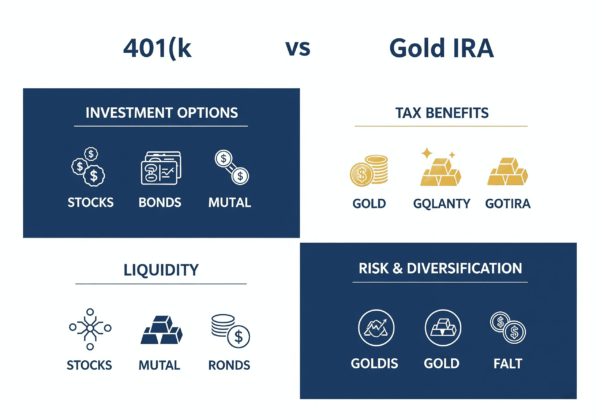
401(k) vs. Gold IRA: Key Comparisons
Investment Options and Flexibility
A traditional 401(k) primarily invests your money in stocks, bonds, and mutual funds, offering a wide variety of choices within the financial markets. These investments can grow over time but are subject to market ups and downs. On the other hand, a Gold IRA focuses on physical precious metals like gold, silver, platinum, and palladium, giving you direct ownership of tangible assets that often behave differently than stocks.
Tax Treatment and Growth Potential
Both 401(k)s and Gold IRAs offer tax advantages. Contributions to a 401(k) are typically made with pre-tax dollars, and your earnings grow tax-deferred until withdrawal. Similarly, Gold IRAs allow your investments in precious metals to grow tax-deferred, or tax-free in the case of a Roth Gold IRA. However, stocks and bonds in a 401(k) may offer dividend income and potentially higher long-term growth, whereas gold’s value depends mostly on price appreciation.
Liquidity and Accessibility
401(k) accounts usually provide high liquidity, allowing you to buy or sell investments quickly within the market. In contrast, Gold IRAs require physical metals to be stored securely at an IRS-approved depository, making the selling process slower and sometimes more complex. This can affect how quickly you can access funds when needed.
Fees and Costs
401(k) plans generally have lower fees because they are managed electronically and often benefit from employer-negotiated rates. Gold IRAs tend to have higher fees due to costs associated with storage, insurance, and specialized custodianship. These fees can reduce your overall returns and should be factored into your decision.
Risk and Diversification
401(k) investments expose you to market risks, including stock market crashes or bond market fluctuations. A Gold IRA offers a way to diversify by including a physical asset that often moves independently of stocks and bonds. This can lower your portfolio’s overall risk and provide a buffer during market downturns.
| Feature | 401(k) | Gold IRA |
|---|---|---|
| Investment Options | Stocks, bonds, mutual funds via financial markets. | Physical gold, silver, platinum, and palladium. |
| Tax Benefits | Pre-tax contributions with tax-deferred growth. | Tax-deferred or tax-free (Roth) precious metals growth. |
| Liquidity | High – easy to trade or withdraw funds. | Lower – requires time to sell physical assets. |
| Fees | Typically lower – often covered by employer plans. | Higher – includes storage, insurance, and custodian fees. |
| Diversification | Limited to paper assets. | Includes tangible assets, hedging market volatility. |
Pros and Cons of Rolling Over Your 401(k) into a Gold IRA
The Benefits of a Gold IRA Rollover
One of the biggest advantages of rolling over your 401(k) into a Gold IRA is protection against inflation. Gold has historically held its value during periods of rising prices, making it a trusted hedge when the cost of living goes up. If you’re concerned that your retirement dollars won’t go as far in the future, gold may offer a form of long-term financial security.
Another major benefit is portfolio diversification. Most 401(k)s are heavily tied to paper-based assets like stocks and mutual funds. While these can offer growth, they also carry risk, especially during market downturns. By moving part of your retirement savings into a Gold IRA, you introduce an asset class that tends to move independently of the stock market. This reduces your overall risk exposure.
Gold is also known as a safe haven asset. During periods of geopolitical tension, recession fears, or currency devaluation, gold prices often remain stable or rise. This can give you peace of mind, knowing that a portion of your retirement is insulated from market panic or government policy changes.
In addition, a Gold IRA offers tax-deferred or tax-free growth, depending on whether you use a traditional or Roth structure. Like your 401(k), you won’t owe taxes until you withdraw funds — or you could avoid taxes altogether with a Roth Gold IRA if eligibility requirements are met.
The Drawbacks You Should Consider
Despite its benefits, a Gold IRA isn’t without downsides. One of the biggest concerns is cost. Gold IRAs typically come with higher fees compared to traditional 401(k)s. You’ll pay for account setup, annual custodial fees, and secure storage for your precious metals. These extra expenses can eat into your returns, especially over the long term.
Another potential downside is that gold doesn’t produce income. Unlike stocks that pay dividends or bonds that offer interest, physical gold doesn’t generate cash flow. Its value relies entirely on price appreciation, which means your gains depend on market demand and global trends.
Liquidity can also be an issue. Selling physical gold from your IRA isn’t as fast or easy as selling stocks. You’ll need to work through your custodian, and it may take time to process the sale and access your funds. This could be a problem if you need money quickly in retirement.
There’s also the issue of IRS regulations. You’re not allowed to store the gold at home — it must be kept in an approved depository. This removes personal control over your asset and adds another layer of cost and administration.
Finally, while gold is often stable during economic uncertainty, it’s still subject to price volatility. There’s no guarantee that gold’s value will always go up, and timing the market can be just as tricky as with stocks or other assets.
| Pros | Cons |
|---|---|
| Offers protection against inflation by holding a historically stable asset. | Higher fees for setup, annual custodianship, and precious metal storage. |
| Diversifies your retirement portfolio beyond traditional paper-based assets. | Gold doesn’t generate income like dividends or interest. |
| Acts as a safe haven during times of market volatility or geopolitical risk. | Physical gold can be harder to liquidate quickly compared to stocks. |
| Eligible for tax-deferred or tax-free growth depending on IRA type. | IRS rules prevent personal storage; metals must be kept in an approved depository. |
| Can provide long-term wealth protection during financial downturns. | Gold prices can still fluctuate and don’t guarantee steady returns. |
Is Rolling Over Your 401(k) into a Gold IRA Right for You?
Rolling over your 401(k) into a Gold IRA isn’t a one-size-fits-all decision. Whether it’s a smart move depends on your individual financial situation, retirement goals, risk tolerance, and how close you are to retirement. It’s essential to understand both the potential benefits and the trade-offs before making a shift from traditional investments to physical precious metals.
Ideal Candidates for a Gold IRA Rollover
If you’re someone who is deeply concerned about stock market volatility, you may be a strong candidate for a Gold IRA. Many investors worry about sudden crashes or long-term instability in the equity markets, especially after experiencing major downturns like those in 2008 or 2020. In these cases, gold can offer a stable alternative that doesn’t move in tandem with stocks.
Another group that might benefit from a Gold IRA includes those who are especially worried about inflation. When inflation rises sharply, the value of cash and fixed-income investments tends to decline. Gold, on the other hand, has a long history of retaining its purchasing power, which can make it an appealing hedge in a retirement portfolio.
Retirees and individuals approaching retirement age are also good candidates for a Gold IRA rollover. If you’re looking to diversify your assets and reduce your exposure to stock market risk, adding physical gold can bring balance to your portfolio. This is particularly important for those who can’t afford to take big losses close to or during retirement.
Lastly, if you’re comfortable with the added costs and administrative complexity that come with managing a Gold IRA, you may find it worthwhile. These investors are usually focused on long-term stability over short-term gains and are willing to pay higher fees in exchange for peace of mind and asset protection.
When You Should Be Cautious
A Gold IRA rollover might not be right for everyone, especially if you expect to need quick access to your retirement funds. Physical gold is not as liquid as stocks or mutual funds — selling it can take time, and you may not always get the exact market price due to fees and spreads. If liquidity is a priority, you may want to reconsider.
You should also be cautious if you’re still early in your career. Younger investors typically have more time to ride out market volatility and benefit from long-term growth in stocks and index funds. Locking up a portion of your savings in gold, which doesn’t produce income or dividends, could limit your growth potential over time.
Another situation where a Gold IRA may not make sense is if you’re sensitive to fees or dislike administrative complexity. Gold IRAs often come with setup charges, storage costs, annual maintenance fees, and strict IRS regulations. If these factors feel burdensome or unnecessary for your strategy, sticking with a traditional 401(k) or IRA may be a better fit.
Final Thoughts
Rolling over your 401(k) into a Gold IRA is a significant financial decision — one that shouldn’t be rushed. It’s not just about buying gold; it’s about rethinking how you want to protect and grow your retirement savings. While gold can offer strong protection against inflation, stock market crashes, and economic instability, it also comes with higher costs and less liquidity.
If you’re nearing retirement or have a low tolerance for market volatility, a Gold IRA could be a smart way to preserve your wealth. It may help diversify your portfolio and provide long-term security. On the other hand, if you’re early in your investing journey and focused on growth, keeping your 401(k) in traditional investments might make more sense for now.
The key is to align your retirement strategy with your personal financial goals, risk appetite, and investment timeline. Consult with a financial advisor or tax professional before making the move, especially if you’re unsure how it fits into your broader plan.
Gold isn’t a magic bullet but for the right investor, it can be a powerful tool in a balanced retirement strategy.
Frequently Asked Questions
Author